
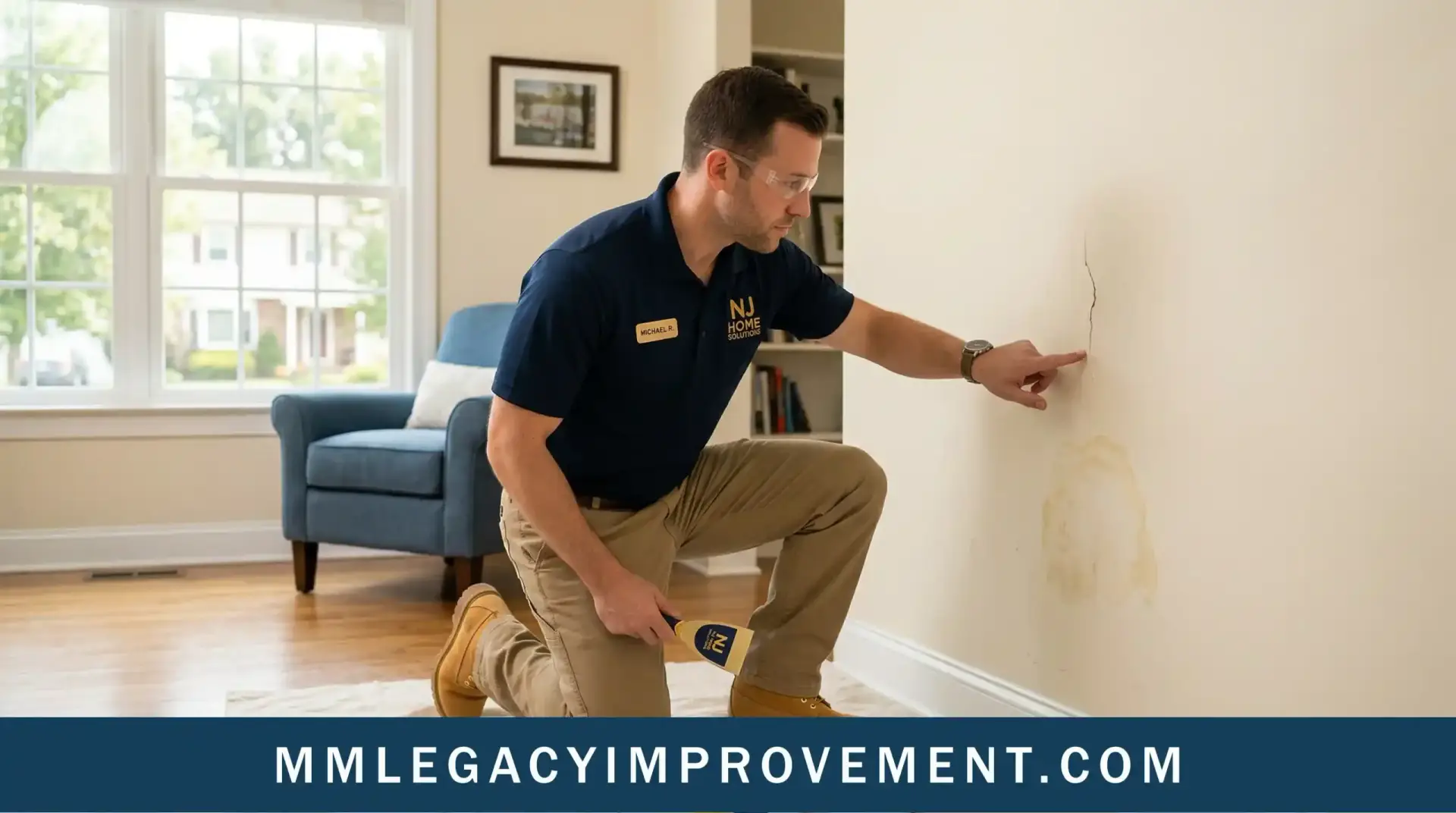
5 Signs Your Drywall Needs to Be Repaired (Not Replaced)
Drywall issues are one of the most common calls we get from homeowners across Monmouth and Ocean County. Whether it’s a small crack near a door frame, a water stain on the ceiling, or a hole from a doorknob the first question is always the same: Do I need to repair it, or replace the whole thing?
The good news is that most drywall problems can be fixed with a targeted repair no need to tear out an entire wall. But there are situations where repair is just a temporary band-aid, and replacement is the smarter, longer lasting choice.
Here are the 5 most important signs to look for, and what they mean for your home.
Sign #1 Small Cracks Near Doors, Windows, or Corners
Small hairline cracks typically less than 1/4 inch wide are extremely common in NJ homes, especially in older construction in towns like Howell, Freehold, and Jackson. These cracks are almost always caused by natural settling of the home’s foundation or seasonal temperature changes that cause slight expansion and contraction in the framing.
The good news: these are ideal candidates for drywall repair. A contractor can fill them with joint compound, sand smooth, and repaint often completing the repair in under two hours.
| ✅ Signs it’s a REPAIR | ⚠️ Signs it needs more attention |
| Hairline crack, less than 1/4″ | Crack is widening over time |
| Only in one area, no pattern | Multiple cracks in same location |
| No water staining nearby | Crack accompanied by bowing |
Sign #2 Holes from Doorknobs, Nails, or Accidents
A doorknob punched through drywall, a large nail hole left from a removed TV mount, or an accidental impact — these are probably the most common drywall repairs we handle at M&M Legacy. They look dramatic, but they’re almost always repairable.
Small holes under 4 inches in diameter can be filled with mesh patch kits and joint compound. Larger holes (4–12 inches) require a “California patch” or a wooden backer board. In either case, a proper repair is fast, clean, and invisible when painted correctly — most homeowners can’t tell the difference after.
When does a hole need replacement instead? If multiple holes are clustered together, or the surrounding drywall feels soft or crumbly, it’s a sign of deeper structural moisture that a simple patch won’t solve.
Sign #3 Water Stains or Bubbling Paint
This one is critical. A yellow or brown stain on your ceiling or wall — often with a slightly raised or bubbly paint surface — tells you that water has been sitting against the drywall. This could be from a leaky pipe, a roof issue, a window seal failure, or condensation in a poorly insulated wall.
Important Warning
Never repair water-stained drywall before finding and fixing the water source…
Once the leak is confirmed fixed, a contractor will assess whether the drywall is structurally compromised:
- ✅ Repair: If it feels firm and dry — repair with fresh compound and a stain-blocking primer.
- 🔄 Replace: If it’s soft, crumbles, or shows mold — the drywall panel must be replaced entirely.
Sign #4 Popping or Visible Nail/Screw Heads
If you see small circular bumps popping through your painted wall surface, those are nail pops — a very common issue in NJ homes built in the 1980s–2000s. Over time, wood framing shrinks and dries, causing drywall fasteners to push outward through the surface.
This is a repair-only situation. A professional will drive the nail or screw in further, add a new screw nearby to secure the panel, apply joint compound over the dimple, sand smooth, and repaint. It takes about 15 minutes per nail pop and the result is a perfectly smooth wall. No replacement needed.
Sign #5 Mold or Dark Spots Behind or On the Drywall
If you’re renovating and pull back a section of wall — or notice dark greenish-black spots appearing through paint — you may be dealing with mold growth inside the wall cavity. This is the one situation where repair is not sufficient.
Moldy drywall cannot be remediated safely by patching. The affected drywall panels must be removed, the cavity inspected and treated by a certified mold remediation professional, and then new drywall installed. In New Jersey, this process often requires an inspection and documentation for insurance purposes.
NJ Contractor Tip
Always ask your contractor if they are licensed under NJ HIC (Home Improvement Contractor) regulations before any drywall work. Unlicensed work can void your homeowner’s insurance and create issues during home sales. M&M Legacy NJ HIC License: #13VH13912600
Quick Reference: Repair or Replace?
| Drywall Issue | ✅ Repair | 🔄 Replace |
| Hairline cracks (settling) | Yes | — |
| Small holes < 12 inches | Yes | — |
| Nail/screw pops | Yes | — |
| Water stain (source fixed, firm) | Yes | — |
| Water stain (soft, crumbling) | — | Yes |
| Mold visible on drywall | — | Yes |
| Large area of bowing/buckling | — | Yes |
| Multiple overlapping holes | — | Yes |
When to Call a Professional
For most homeowners, the question of repair vs. replace can be answered by a quick visual inspection. But if you’re seeing soft spots, bubbling, mold, or you’re not sure what caused the damage always get a professional assessment before spending money on materials.
At M&M Legacy Home Improvement, our drywall experts serve Howell, Freehold, Jackson, Manalapan, Marlboro, and all of Monmouth & Ocean County, NJ. We’ll assess the damage honestly, give you a clear quote, and get the job done right the first time — whether that’s a 30-minute patch or a full panel replacement.
Ready for a Fresh Coat?
Get Your Free Quote Today.
We serve Howell, Freehold, Jackson and 30+ NJ cities. Response within 24 hours — no obligation, no pressure.
+1 (609) 598-6049